

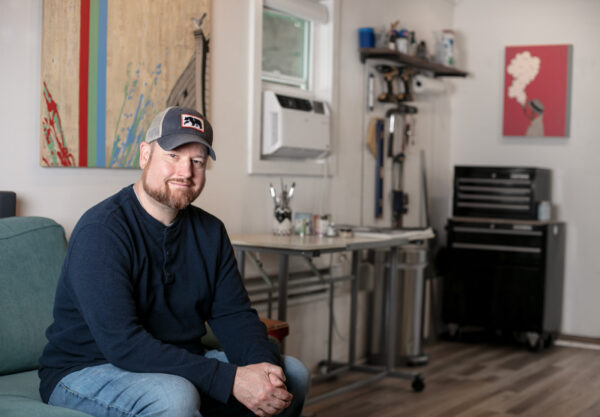
Studio Practice
Bill Porter is a Boston-based Irish-American multidisciplinary artist whose research-driven practice examines how beliefs, assumptions, and cultural narratives shape perception and influence what we understand as truth. Working primarily in painting, alongside installation and mixed-media practices, he investigates how inherited narratives become embedded in the systems, images, and conventions through which we make sense of the world.
Grounded in his experience as a Blind artist with low vision and informed by the collective realities of the blind and low vision community, my work investigates the cultural construction of blindness and disability. Bill is particularly interested in how representation, language, and social systems shape perception and reinforce ableist assumptions, and how lived experience can challenge those narratives.
Teaching
Bill is an Adjunct Professor at Lesley Art + Design, where he has taught studio art courses since 2015 in the Integrated Studies and Animation & Motion Media departments and has served as a faculty juror for BFA Junior and Senior Animation film reviews. Beyond higher education, he teaches online and in-person studio classes for artists with disabilities. He works with the Isabella Stewart Gardner Museum’s Access Studio program as a consultant for program development and as a teaching artist. He also serves as rotating faculty at Dark Room Ballet, where he teaches Developing a Contemporary Art Practice, a 16-week online studio course for blind and low vision artists, and the seminar Blindness as Method: Contemporary Art and Creative Practice.
Education
MFA in Visual Arts, Art Institute of Boston at Lesley University, 2015
BFA in Animation, University of Massachusetts, Amherst, 1998
Certificate in Film Studies, University of Massachusetts, Amherst, 1997
Disability & Advocacy
Bill proudly identifies as Blind and low vision, with vision that has progressively evolved since birth due to an inherited retinal disorder. His lived experience shapes both his creative practice and his advocacy. Bill works to advance accessibility, equity, and disability rights, with a focus on amplifying the perspectives of disabled people in public, cultural, and educational spaces.
He has spoken at venues ranging from university classrooms to international summits, sharing insights on disability, inclusion, and creative practice. Beyond public speaking, Bill has organized campaigns, curated exhibitions, and hosted panels that center disabled voices and challenge ableist assumptions. His work reflects a commitment to building community and creating platforms that recognize disabled people as leaders, storytellers, and change-makers.
Leadership & Community Engagement
For more than three decades, Bill has served in leadership roles across education, creative practice, and community organizations. The positions highlighted below reflect his recent work advancing equity and inclusion, fostering community, and contributing lived experience and creative perspectives to institutional change.
Bill is an inaugural member of the Table of Voices Steering Committee at the Museum of Fine Arts, Boston. The committee brings community leaders, advocates, and organizers into sustained collaboration with the museum to inform exhibitions and gallery experiences, expand approaches to interpretation and storytelling, and strengthen connections between the MFA and communities across Boston.
At Lesley University, he founded the Disability Advocacy and Education Group in 2021 and served as co-chair during its first two years, helping to establish its mission and activities. He remains an active member. Bill has also served on the University’s Diversity Council and the Lesley Art + Design Equity, Diversity, and Justice Committee, where he chaired a working group focused on equity, bias, and belonging within studio critique culture.
Scholarship
Since 2017, Bill has collaborated with a five-member, cross-disciplinary faculty team at Lesley University to research effective peer critique/feedback practices. As part of this work, he co-developed and refined a three-step protocol for student-led peer review, which the team has presented at national and international conferences. Their research culminated in the 2022 publication Student-Led Peer Review: A Practical Guide to Implementation Across Disciplines and Modalities, providing educators with a practical framework adaptable across disciplines and learning environments.
From 2015 to 2016, Bill participated in the Visual Literacy inFUSION Project, a Davis Grant–funded faculty learning community exploring visual literacy across disciplines. He was a member of the faculty cohort, Decoding Mass Media: Deconstructing TV, Cinema, and Photography in Your Courses.
Bill’s current research focuses on critical disability studies, with particular attention to the cultural history of blindness, the contemporary disability arts movement, the aesthetics of access, and how ocularcentrism shapes art education, identity, pedagogy, and approaches to artistic description and presentation.
Professional Work History
Before 2014, Bill worked as a professional artist and designer across multiple disciplines, including character animation, motion media, illustration, multimedia design, video production, graphic design, and photography. He created character-driven, interactive educational media and animated promotional videos for clients such as PBS Kids, Addison Wesley, and the Aardvark Design Group. As a motion graphics designer, he collaborated with clients in broadcast (WHDH CW56), technology (HP), and government (US Secret Service).
Bill also directed and edited videos for organizations including Simmons University, Boston College, and Coldwell Banker, and designed characters and environments for website interfaces and marketing materials as a freelance illustrator. His illustrations have appeared in textbooks and publications in seven countries spanning North America, South America, and Europe.