

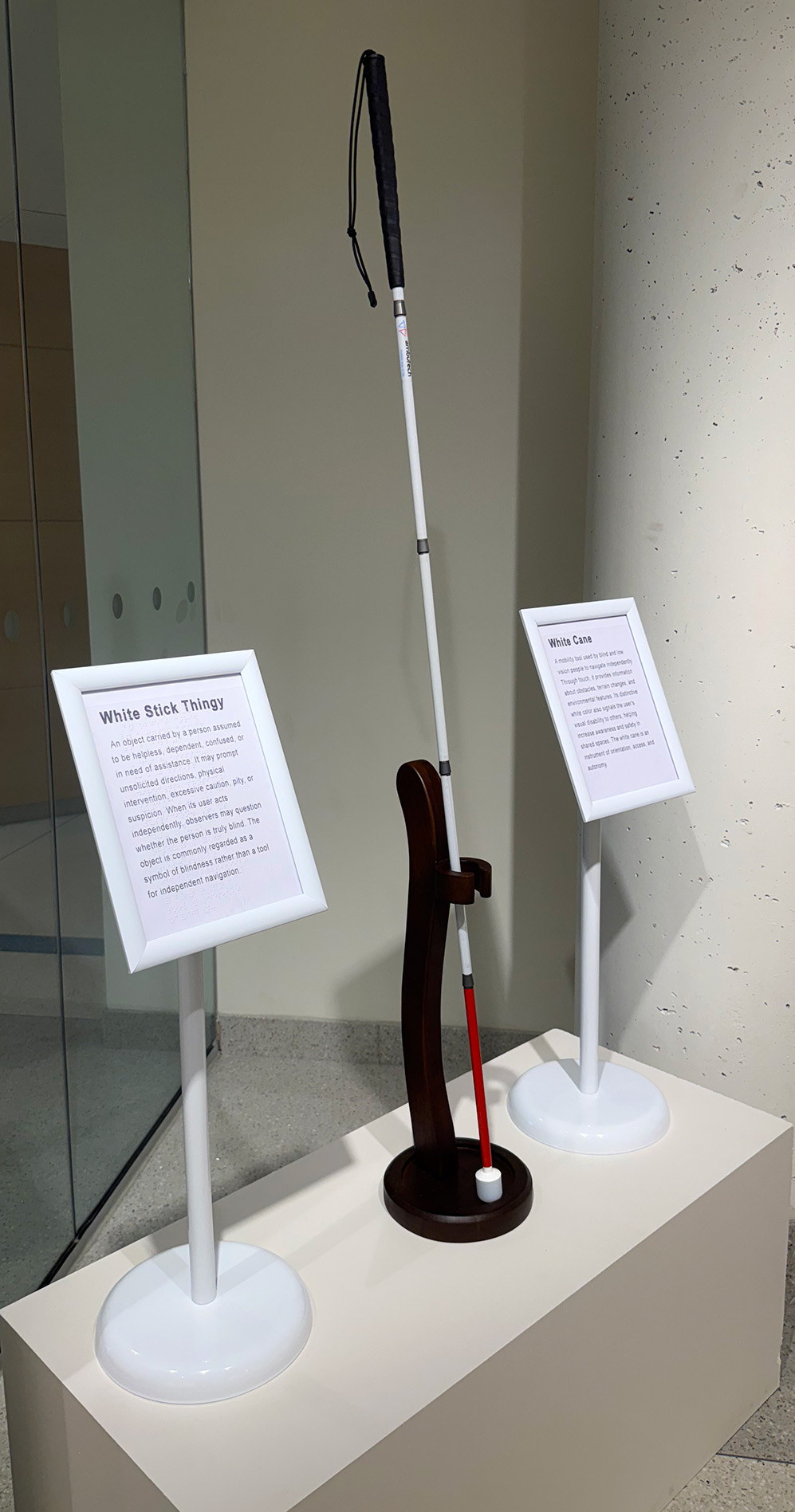
 Terms of Use. Walnut cane stand, white aluminum cane, printed signs. Dimensions vary. 2026.
Visual Description
A white mobility cane stands upright in a dark walnut wooden holder on an off-white pedestal, positioned between two framed interpretive signs. The installation is presented in a gallery space with glass walls and a concrete column in the background.
The cane has a black handle, a long white aluminum shaft, and a red section near its lower end. It rests vertically in a cylindrical walnut holder attached to a circular wooden base.
Two signs flank the cane, resembling museum interpretive labels. The sign on the left is titled White Stick Thingy, while the sign on the right is titled White Cane. Each presents a different interpretation of the same object.
Left Sign: White Stick Thingy
An object carried by a person assumed to be helpless, dependent, confused, or in need of assistance. It may prompt unsolicited directions, physical intervention, excessive caution, pity, or suspicion. When its user acts independently, observers may question whether the person is truly blind. The object is commonly regarded as a symbol of blindness rather than a tool for independent navigation.
Right Sign: White Cane
A mobility tool used by Blind and low vision people to navigate independently. Through touch, it provides information about obstacles, terrain changes, and environmental features. Its distinctive white color also signals the user’s visual disability to others, increasing awareness and safety in shared spaces. The white cane is an instrument of orientation, access, and autonomy.
Overall Composition
The installation uses the familiar presentation of a museum artifact to place two contrasting interpretations of the same object in conversation. The cane remains unchanged between the signs, while the language shifts from cultural assumptions about blindness to a description grounded in function, independence, and autonomy.